CRITERIA TO KNOW
WHEN CHOOSING A DIAMOND
Choosing a diamond is no easy task. To appreciate its value, you first need to know
know how to value it.
Diamond evaluation criteria
There are four main criteria to consider when buying a diamond: the 4Cs.
Cutting quality does not refer to the shape of the diamond (round, oval, pear, etc.) but to its proportions, symmetry and polish.
Although extremely difficult to analyze and quantify, diamond cutting has three effects on the overall appearance of the stone:Cutting quality refers not to the shape of the diamond (round, oval, pear, etc.) but to its proportions, symmetry and polish.
Although extremely difficult to analyze and quantify, diamond cutting has three effects on the stone’s overall appearance:
- Brilliance: the clarity created by reflections of white light on the surface and inside the diamond.
- Fire: the dispersion of light by different spectral colors.
- Scintillation: the contrast between black and white caused by the reflection of light.
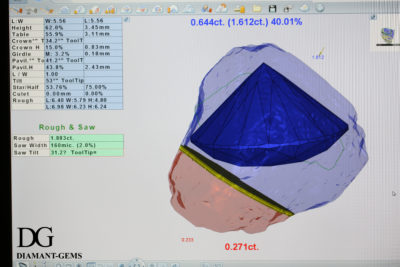
When cutting a rough diamond, the cutter must achieve an optimal cut while retaining the maximum amount of material.
The proportions of cut diamonds
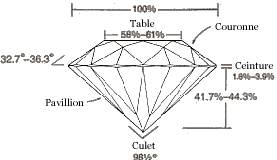
Proportions refer to the relationship between the cut (size), shape and angles of each diamond facet.
A wide range of combinations is possible, depending on the diamond’s relationship with light.
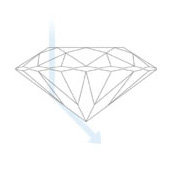
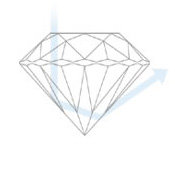
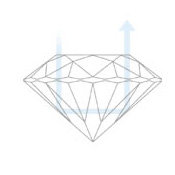
When light hits a diamond, approximately 20% of the light is immediately reflected away from the diamond’s surface. Of the remaining 80%, a portion escapes towards the shell of the diamond (where the observer cannot see the reflection).
A well-proportioned diamond will have each facet neatly positioned and angled to maximize the amount of light that will reflect off the diamond’s crown, and thus to the observer’s eyes.
This reflected light on the diamond is perceived as sparkle, fire and brilliance.
The depth of diamonds
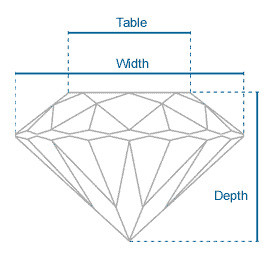
The depth represents the distance between the culet and the diamond table.
The percentage of diamond depth is calculated by dividing the depth by the width. So if a diamond is 3 mm deep and 4.5 mm wide, the depth will be 66.7%.
Diamond table (%)
The table(%) of the diamond is calculated by dividing the width of the table as a facet with the width of the diamond. So if the table is 2 mm and the diamond width 3.5 mm, the table is 57%.
The different qualities of diamond cut
“Excellent”: Maximum fire and brilliance. The diamond reflects virtually all the light that enters the stone, creating maximum sparkle and life.
“Very Good” : The diamond cleanly reflects almost all the light that enters the stone, producing fire and very good brilliance. Under normal lighting conditions, Very Good looks almost exactly like an excellent cut at a lower price.
“Good” : Diamond reflects most of the light that enters the stone, achieving a good overall appearance.
“Fair” : Much of the light that enters the stone escapes at the sides or ends of the diamond. The “fair” cut is no longer acceptable.
“Poor” : Most of the light that enters the diamond escapes at the sides or ends. The diamond will therefore be dull and lifeless.
Current techniques for optimizing diamond cutting
The sarin is an optical machine connected to a computer. It is a versatile instrument commonly used by laboratories and diamond cutters. It can be used to detect the potential of a rough diamond, or to determine the cut quality of a cut diamond. Once the diamond is positioned on the sarin, it will give its exact characteristics (such as the weight after recutting of a rough diamond).
Sarin is also used to perfect the cut of a diamond. Diamonds with an old cut, for example, need to be recut. Sarin offers optimum solutions to improve a diamond’s proportions and symmetry. She simply gives instructions to the tailor, who applies them in order to achieve the desired cut.
We recommend considering each diamond in its entirety, the 4Cs as a whole, rather than looking at the criteria individually. The key to choosing the right quality criteria is to define the priorities that best suit you.
VISUALIZE THE SIZE OF
DIFFERENT DIAMOND CARATS
Diamond purchase security
When choosing your diamond, it’s best to use a lamp that produces a light as close to daylight as possible. In most jewelry stores, yellow-spectrum lamps are used; they enhance the diamond’s brilliance, but artificially; once outside, facing daylight, the diamond’s brilliance is suddenly much less good!!! It’s essential to select your diamond using a “cold” light that reproduces the outside luminosity that comes from the North between 12 and 2 p.m.
The certificate must accompany your diamond. This gemological report lists all the diamond’s main characteristics, and is a veritable identity card for your stone. We recommend the following laboratories: G.I.A., H.R.D. and I.G.I.
Laser engraving of the certificate number on the diamond’s rondiste (circumference) is a “must”. It allows complete traceability of your diamond. You’ll learn to recognize your stone by yourself, thanks to a 20x magnifying glass.
Beware of treated and HTHP stones. You’ll only find natural diamonds with us; the certificates will confirm it.
Clarity-enhanced or color-enhanced diamonds have been artificially modified (purity or color); the price of such a diamond drops sharply (-70 to -80%).
If you buy a diamond without a certificate, you run the risk of unknowingly buying a treated stone!
DISCOVER OUR CATALOGUE
OF CERTIFIED DIAMONDS
Our tips for choosing a diamond
We advise you to choose diamonds with purity between IF (pure) and VS2 and color between D and F if you opt for an “investment diamond”. A VVS or Pure diamond will be more valuable financially than one with VS or SI clarity. If you are looking for a diamond to be worn on a daily basis as part of a “pleasure” purchase, a clarity between VS2 and SI2 is suitable.
As for color, stick to the D, E, F or G colors if the diamond is to be set in white gold or platinum. For yellow gold, the H or I colors are correct, as yellow gold makes the stones appear whiter than they really are.
It’s also important to buy diamonds at market price. There is a price list of cut diamonds available by subscription for professionals, called the “Rapaport Diamond Report”. This list gives the price of all diamonds from 0.01 carat to 10 carats, according to weight, color, purity and cut shape. It is used daily by diamond dealers and traders worldwide in their transactions. It is the diamond price.
We recommend considering each diamond in its entirety, the 4Cs as a whole, rather than looking at the criteria individually. The key to choosing the right quality criteria is to define the priorities that best suit you.
PLEASE DO NOT HESITATE TO CONTACT US FOR
ANY REQUEST FOR AN APPOINTMENT
Our offices in Paris and Antwerp are open Monday to Friday from 9:30 am to 6:30 pm without interruption.