





WHAT YOU NEED TO KNOW
WHEN CHOOSING A DIAMOND
Choosing a diamond is not an easy task. To appreciate its value,
you first need to know know how to appraise it.
Diamond evaluation criteria
There are four main criteria to consider when buying a diamond: the 4Cs.


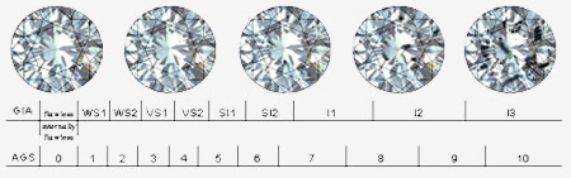
A diamond’s purity, expressed from “IF” to “P”, can only be determined by a diamond expert. It is assessed by the number and position of inclusions, or slight crystallizations, in the stone. To assess a diamond’s purity, it is necessary to study the number and position of inclusions in the stone. Inclusions are deformations or accidents that occurred during a diamond’s formation within the Earth, when it came into contact with different materials, or when it encountered variations in temperature or pressure, which explains their diversity.
Various international standards have been established and, schematically, they are summarised as follows: “IF”, “VVS”, “VS”, “SI” and “P”.
“IF” (Pure) : This class corresponds to the highest degree of purity. This means that in normal light when examined under a microscope, the diamond must be free of inclusions.
“VVS” (Very Very Small Inclusions) : in this case there are very very small inclusions that are difficult to detect under a microscope.
“VS” (Very Small Inclusions ) : this designation characterises stones containing very small inclusions that are difficult to see when enlarged 10 times.
“SI” (Small Inclusions) : ) this is the next degree down in the scale of purity. It applies to gems whose inclusions are small, but easy to see when enlarged 10 times.
Included 1 : this category includes diamonds with inclusions, which although discernible, are barely visible to the naked eye when viewed through the crown.
Included 2 : this category applies to diamonds with inclusions, that may be in large numbers or not but are relatively large, and visible to the naked eye through the crown.
Included 3 : this category features all diamonds with large inclusions, that are easily spotted with the naked eye through the crown and in such quantity that they seriously affect the brilliance of the stone.
We recommend considering each diamond in its entirety, the 4Cs as a whole, rather than looking at the criteria individually. The key to choosing the right quality criteria is to define the priorities that best suit you.
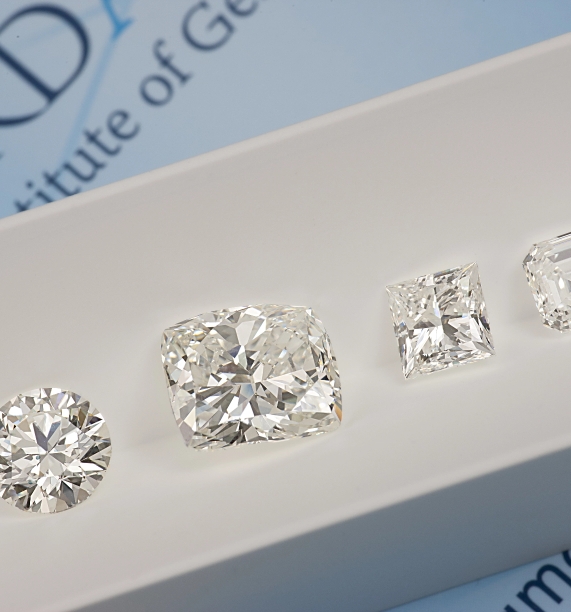
VISUALIZE THE SIZE OF
DIFFERENT DIAMOND CARATS
Diamond purchase security
When choosing your diamond, it’s best to use a lamp that produces a light as close to daylight as possible. In most jewelry stores, yellow-spectrum lamps are used; they enhance the diamond’s brilliance, but artificially; once outside, facing daylight, the diamond’s brilliance is suddenly much less good!!! It’s essential to select your diamond using a “cold” light that reproduces the outside luminosity that comes from the North between 12 and 2 p.m.
The certificate must accompany your diamond. This gemological report lists all the diamond’s main characteristics, and is a veritable identity card for your stone. We recommend the following laboratories: G.I.A., H.R.D. and I.G.I.
Laser engraving of the certificate number on the diamond’s rondiste (circumference) is a “must”. It allows complete traceability of your diamond. You’ll learn to recognize your stone by yourself, thanks to a 20x magnifying glass.
Beware of treated and HTHP stones. You’ll only find natural diamonds with us; the certificates will confirm it.
Clarity-enhanced or color-enhanced diamonds have been artificially modified (purity or color); the price of such a diamond drops sharply (-70 to -80%).
If you buy a diamond without a certificate, you run the risk of unknowingly buying a treated stone!


DISCOVER OUR CATALOGUE
OF CERTIFIED DIAMONDS
Our tips for choosing a diamond
We advise you to choose diamonds with purity between IF (pure) and VS2 and color between D and F if you opt for an “investment diamond”. A VVS or Pure diamond will be more valuable financially than one with VS or SI clarity. If you are looking for a diamond to be worn on a daily basis as part of a “pleasure” purchase, a clarity between VS2 and SI2 is suitable.
As for color, stick to the D, E, F or G colors if the diamond is to be set in white gold or platinum. For yellow gold, the H or I colors are correct, as yellow gold makes the stones appear whiter than they really are.
It’s also important to buy diamonds at market price. There is a price list of cut diamonds available by subscription for professionals, called the “Rapaport Diamond Report”. This list gives the price of all diamonds from 0.01 carat to 10 carats, according to weight, color, purity and cut shape. It is used daily by diamond dealers and traders worldwide in their transactions. It is the diamond price.
We recommend considering each diamond in its entirety, the 4Cs as a whole, rather than looking at the criteria individually. The key to choosing the right quality criteria is to define the priorities that best suit you.
PLEASE DO NOT HESITATE TO CONTACT US FOR
ANY REQUEST FOR AN APPOINTMENT
Our offices in Paris and Antwerp are open Monday to Friday from 9:30 am to 6:30 pm without interruption.